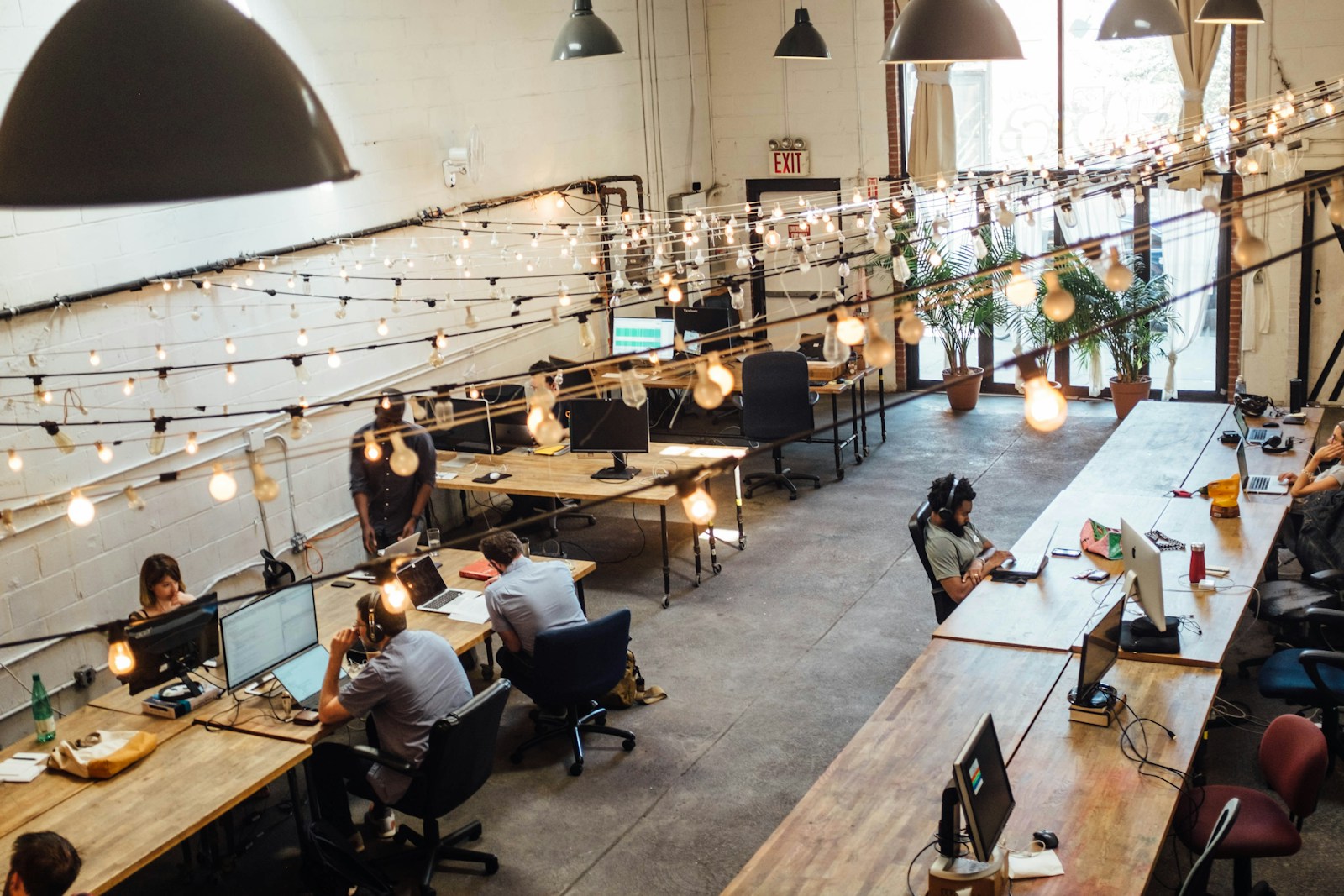
Hot desking is an office setup where desks don’t belong to anyone. Instead of every employee having an assigned seat, people take whatever desk is free when they come in, usually by booking it the same day or a few days ahead. It exists because hybrid work broke the old math: if your team comes in two or three days a week, a desk per person means paying rent on furniture that sits empty most of the time.
That’s the whole concept. The rest of this post is the parts people actually argue about.
Hot desking, hoteling, assigned seats: which is which?
The terms get used interchangeably and they shouldn’t be.
Assigned seating is the classic: one person, one desk, a family photo and a dying plant. Simple, and expensive the moment attendance drops below five days a week.
Hot desking means unassigned desks, claimed day by day. In the strict original sense you just showed up and sat; in practice almost everyone runs it with a booking tool now, because “first one through the door wins” stops being charming at about 20 people.
Hoteling is hot desking with mandatory advance reservation, usually further ahead and often through a stricter system. Think booking a hotel room versus grabbing a table at a café. The line between hoteling and modern hot desking is blurry, and honestly not worth a meeting. What matters is whether desks are shared, not what you call the sharing.
Most offices land on a mix: the majority of desks float, a handful stay assigned to people with three monitors and an ergonomic chair prescription.
The short version, if you’re skimming:
| Who owns the desk | How you get one | Typical office | |
|---|---|---|---|
| Assigned seating | One named person, permanently | You were given it | Full-time, five days a week |
| Hot desking | Nobody | Book it that day or a few days ahead | Hybrid, shared desks |
| Hoteling | Nobody | Mandatory advance reservation | Hybrid, stricter policy |
When hot desking works
It works when attendance is genuinely hybrid and people can see the office before they commute. Those two conditions do most of the lifting. We ran a 110-person office on 60 floating desks for four years and the surprise wasn’t that it worked, it was how little management it needed once everyone could check who’s in from their phone.
It also works financially, because hybrid attendance is structural now, and the data on that is solid: about 25% of paid workdays in the US were worked from home as of May 2026, per Stanford’s Survey of Working Arrangements and Attitudes (Barrero, Bloom, and Davis, June 2026 update). Desks sized for five-day attendance sit a quarter empty on average, before you even look at your own patterns. Sharing desks at roughly a 2:1 people-to-desk ratio is the difference between renewing your lease and outgrowing it, which is usually the reason a company starts googling terms like the one that brought you here.
When hot desking doesn’t work
Honest list, because it’s not for every office:
- Everyone comes the same days. If Tuesday through Thursday is mandated for all, you need close to a desk per person on those days anyway. Fix the policy before the furniture.
- Fixed equipment. Labs, support desks with dedicated hardware, anyone with a medical setup. Assign those seats and let the rest float.
- Nobody can see who’s in. Hot desking without visibility becomes musical chairs with commutes. This is the failure people blame on the concept when it’s really the missing tool.
What you need to run hot desking
Less than the enterprise platforms suggest. A floor map people can book from, a way to see who’s coming in, and a couple of rules (how far ahead you can book, which desks are off limits). That’s the entire category, stripped of the modules.
If you want the longer version of how that plays out day to day, the origin story covers four years of it. And if you’re evaluating tools, Desked is the one we built for exactly this, priced by the desk, not by headcount.
Photo by Shridhar Gupta on Unsplash