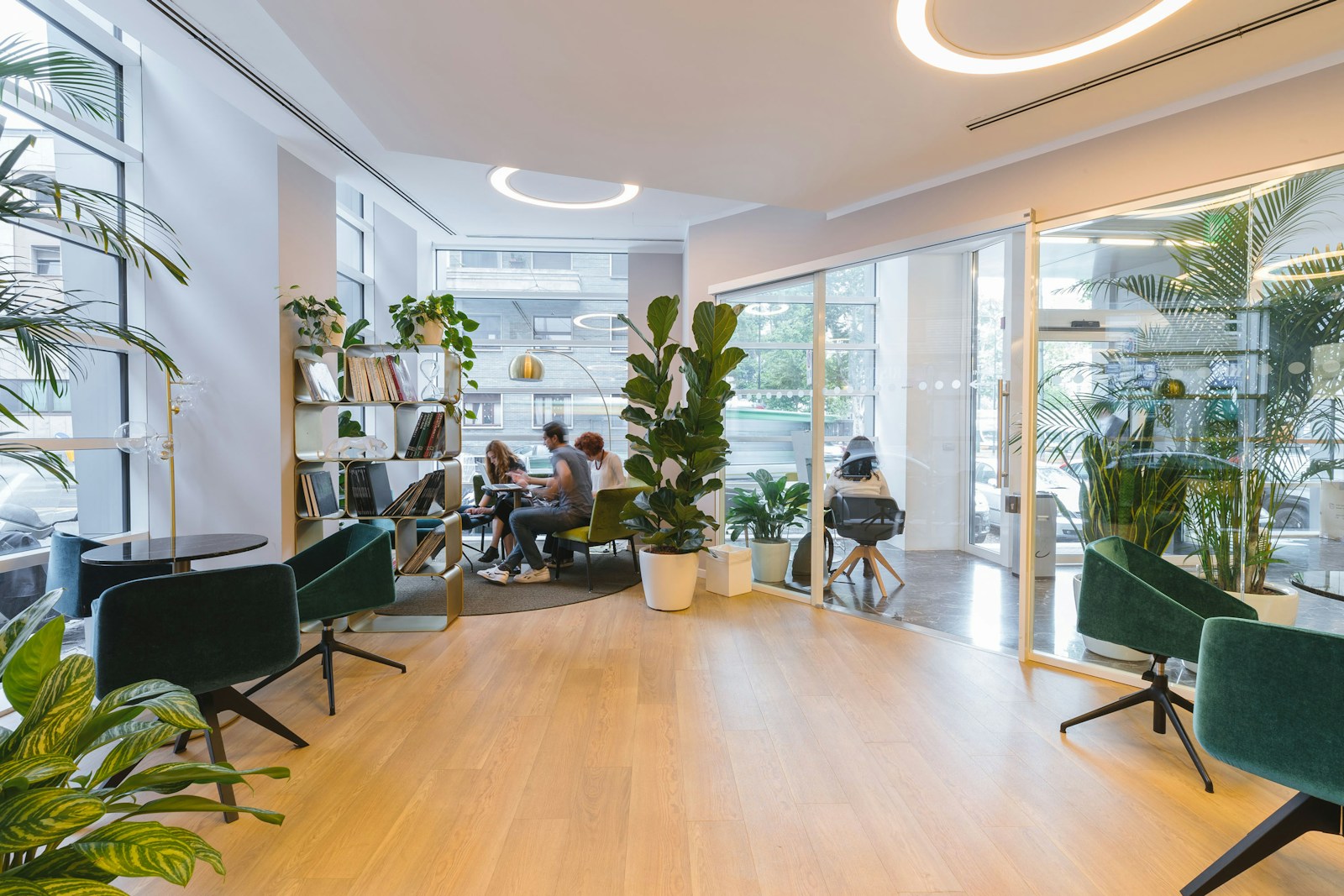
A hybrid office can run on roughly half as many desks as it has people. No assigned seats, no coordinator with a spreadsheet, and a lot less drama than you’d expect. We know because we did it: 110 people, 60 desks, four years and counting. This post is what we learned, including the parts that took us embarrassingly long to figure out.
How does 110 people into 60 desks even go?
The short answer is that nobody comes in every day, and the days they do come are more spread out than you think.
When the office went hybrid, the instinct was to panic about Mondays. Everyone shows up, half of them stand? It never happened. Most days the office sat somewhere around half full, and the busy days peaked around 45 to 50 people, comfortably under the 60 desks. The math only breaks if you mandate the same days for everyone, and then the problem isn’t your desk count, it’s the mandate.
I’ll be honest, we didn’t plan the 2:1 ratio. The company grew past the office and moving was expensive, so the ratio happened to us. The lesson came later: it was never actually a problem. That’s the part worth stealing.
Didn’t people fight over desks?
Less than you’d think, and I’ve thought about why.
The thing that kept it civil wasn’t a rule. It was that everyone could see the office before they commuted. You check who’s in from the kitchen counter, you see your team is going Thursday, you go Thursday. People come in for people, not for furniture, and that spreads the load on its own. The fights we imagined (two people, one window desk, pistols at dawn) mostly never materialized because you could see the desk was taken before you left the house.
What did generate friction, the first year, was the spreadsheet we used before building anything. Somebody forgets to delete a row, somebody edits over somebody else, and now a desk is “taken” by a person who’s in Panamá that week. The spreadsheet phase taught us the actual requirement: it’s not booking, it’s visibility.
Why didn’t we just buy something?
We tried to. That part of the story usually surprises people.
When the spreadsheet gave up on us, we went shopping for desk booking software like anyone would. What we found was a market built for a company we weren’t. The pricing was per person, so our 110 employees would have paid full freight for 60 desks; the whole reason we had a comfortable office was the 2:1 ratio, and the software wanted to charge us as if it were 1:1. Several tools wouldn’t even show a price without a sales call, which is a strange amount of ceremony for “let me see if a desk is free.”
And the products themselves were platforms. Visitor management, room panels, mail tracking, catering modules. We needed a map, a list of who’s in, and a way to book. Paying for a suite to use a tenth of it felt like renting a second office we’d also leave empty.
So we built the small version internally. We were a software company, so we had the unfair option of building it; most offices don’t, which is more or less why Desked exists as a product now. The version you can buy is the one that ran that office, priced by the desk instead of the person, because that’s the pricing that would have made sense to us when we were the buyer.
The rules we thought we’d need but didn’t
We drafted a whole rule system on a whiteboard once. Check-in confirmations, no-show penalties, priority tiers. It felt very thorough.
We shipped almost none of it. What survived: a booking window (you can’t reserve a desk three months out) and a handful of desks assigned to people who genuinely need the same spot, ergonomic setups mostly. That’s it.
Every rule you add creates a job: someone has to enforce it, argue about it, and handle the exception on the day the CEO’s guest needs a desk. The office manager already has a job. In four years, the strongest correlation we saw was that fewer rules meant fewer conversations about rules.
The rule we’re most glad we skipped is the punitive check-in, where a robot deletes your booking if you don’t scan a QR code by 9:30. Tools in this category love it. We think it optimizes the map at the cost of teaching your team the tool is against them.
What actually broke
Two things, honestly.
Sick days. Someone books a desk, wakes up sick, and the desk spends the day empty with their name on it while somebody else works from the kitchen. The fix was letting anyone cancel on a colleague’s behalf, two taps, no guilt. Small feature, disproportionate effect.
And the near-full days. The office as a whole rarely filled, but the popular zone did, and by 8:30 whoever wanted a spot next to their team was refreshing the map hoping for a cancellation. That one bothered us for years, and it’s the itch behind what we’re building now, so I’ll leave it there.
Would this work for your office?
Some honest caveats, because it doesn’t work everywhere.
It works if your attendance is genuinely hybrid, your culture can handle “adults pick their own seats,” and the ratio isn’t wildly off (2:1 people-to-desks was comfortable for us; your number depends on your attendance, not ours). Hybrid itself is no longer the bet it was in 2021: Stanford’s SWAA data has work-from-home holding steady at about a quarter of US paid workdays through 2026, so an office sized for it isn’t sized for a trend. It gets harder if leadership mandates identical days for everyone, or if half the staff needs fixed equipment at a fixed desk. Lab, hardware, support teams with three monitors: assign those and let the rest float.
If you’re staring at a lease renewal, do the boring thing first: measure real attendance for a few weeks before you argue about square footage. The real number is usually lower than the loudest voice in the meeting says. Our 110-person office needed 60 desks and, some days, not even that.
Desked is the internal tool that office turned into, running in offices since 2021. If you want the same setup, the trial takes an afternoon, and it’s the same product we use ourselves.