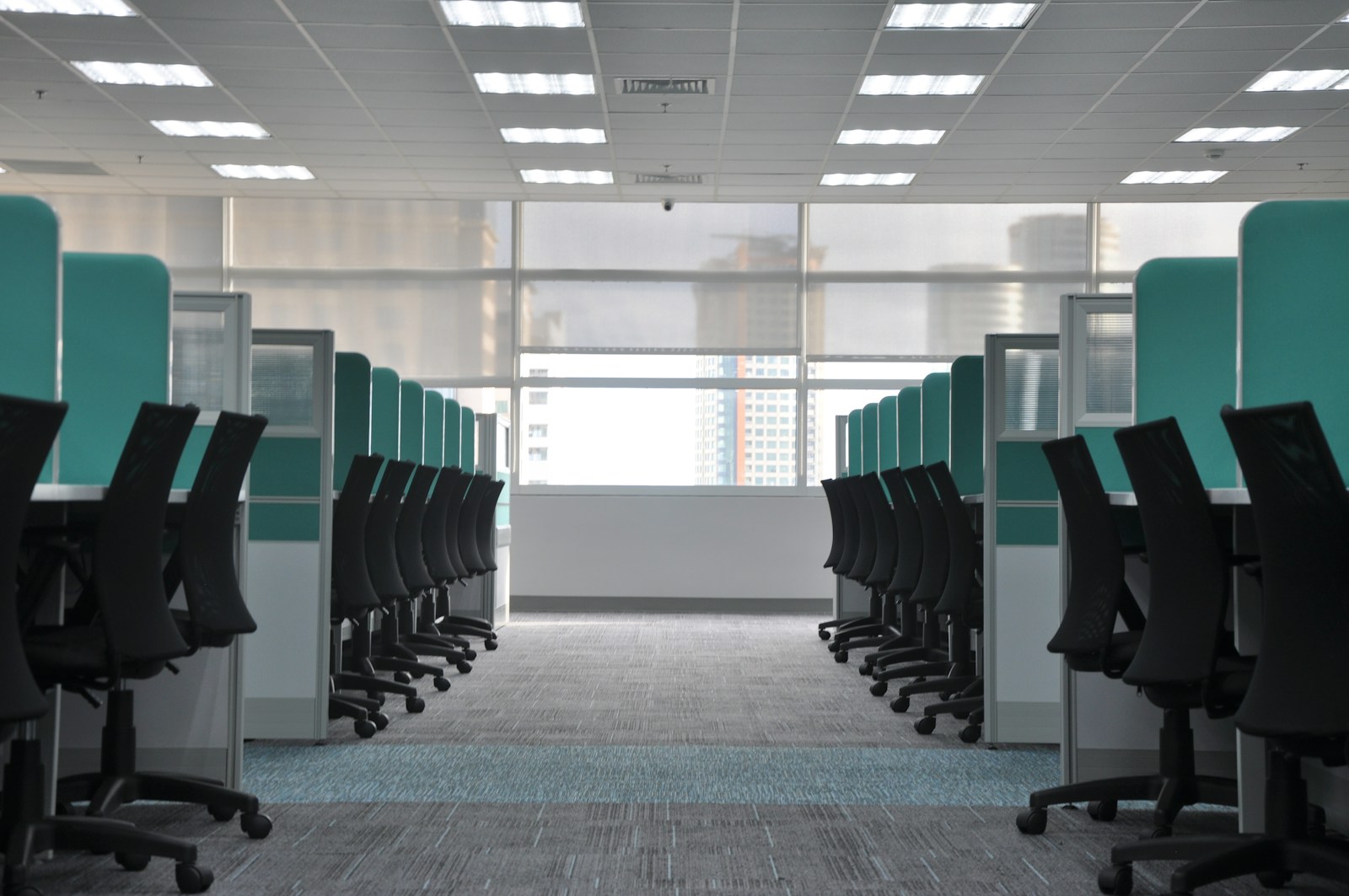
A desk-to-employee ratio is how many desks an office has per employee. A ratio of 1:2 means one desk for every two people. Full-time offices run 1:1 by definition; hybrid offices typically land somewhere between 1:1.5 and 1:2.5, because on any given day most of the team isn’t in. We ran a 110-person office on 60 desks (a 1:1.8 ratio) for four years, so the numbers in this post come from living with them rather than from a benchmark report.
How the ratio is written, so nobody talks past each other
The notation trips people up in meetings. “1:2” here means desks:people, one desk per two employees. Some vendors call the same thing a desk sharing ratio and flip the numbers, some say “0.5 desks per person”, some say “50% desk sharing”. Same office, three notations. Pick one convention internally and write it down; the argument about notation is never worth having twice.
What ratio should you actually run?
It depends on attendance, which sounds like a dodge until you see the direction of it: attendance is the input, and the ratio falls out of it.
| If your average attendance is | Your ratio lands around | Feels like |
|---|---|---|
| 4 to 5 days a week | 1:1 to 1:1.2 | Assigned seats, or barely shared |
| 3 days a week | 1:1.5 | Comfortable sharing, rare full days |
| 2 to 3 days a week | 1:1.8 to 1:2 | Our office. Roomy most days, tight on peaks |
| 1 to 2 days a week | 1:2.5 to 1:3 | Aggressive, works only with spread-out patterns |
Two honest caveats about that table. First, averages hide peaks: if the whole company loves Tuesday, your average says 1:2 and your Tuesday says musical chairs. Size for your busiest regular day, not for the mean. Second, mandated days break the math entirely; if everyone must come Tuesday through Thursday, you need close to a desk per person those days and the ratio conversation is really a policy conversation.
The peak-day math, with a worked example, gets its own post: how many desks does a hybrid team actually need.
What we learned running 1:1.8
Three things surprised us over four years.
The ratio never gave us trouble. Visibility did: the office ran fine once people could see who was in before commuting, and it ran badly in the spreadsheet era at the exact same ratio.
Peaks self-flatten when people can see them coming. Someone checks the map, sees Tuesday filling up, comes Wednesday instead. No policy did that; the map did.
And nobody ever asked for the ratio to change. People asked for their usual desk, for their team to sit together, for a way to cancel a sick colleague’s booking. The ratio is an accounting concept; what employees experience is whether Tuesday morning works.
For calibration against something bigger than our office: Stanford’s Survey of Working Arrangements and Attitudes (June 2026 update) puts US work-from-home at about 1.3 days per week averaged across all workers, and above 2 days in information and finance jobs. If your team looks like the second group, the 1:1.8 to 1:2 rows in the table above are where the national data says you’ll land too.
The money side, briefly
Every desk you don’t need is rent, and every desk-booking tool that charges per employee taxes the ratio itself: at 1:2 you’d pay for twice the people you have desks. That mismatch annoyed us enough as a buyer that when we turned our internal tool into Desked, we priced it by the desk. Your ratio improving shouldn’t make your software more expensive.
If you’re picking a ratio this quarter: measure attendance for a few weeks, find your busiest regular day, add a small buffer, and let the booking data correct you. The ratio you compute today is a guess; the one your occupancy report shows you in month two is real.